Lifesaving programme to prevent post-birth bleeding wins Times Higher Education STEM Award

A cost-effective intervention for postpartum haemorrhage, which has reduced maternal deaths worldwide by 60%, has won a major award in UK Higher Education.

The E-MOTIVE programme led by BHP founder-member the University of Birmingham and the World Health Organisation (WHO), with partners around the world, has been awarded Times Higher Education’s 2025 STEM award for best research in science, technology, engineering or mathematics.

Members of the E-MOTIVE team collect their award

The award was given to the low-cost set of interventions, which are being used to reduce deaths from childbirth-related bleeding – the leading cause of maternal mortality worldwide. It affects an estimated 24 million women each year and results in around 70,000 deaths – mostly in low and middle-income countries – equivalent to one death every seven minutes.

Professor Adam Devall from the University of Birmingham and an author of the study said: “We are delighted that E-MOTIVE has received recognition from the Times Higher Education awards, demonstrating the high calibre of research undertaken at the University of Birmingham.

“Childbirth-related bleeding is a major risk to life for women around the world, affecting an estimated 24 million women each year. E-MOTIVE is a powerful toolkit that is already being employed globally to dramatically reduce the numbers of women dying from excessive bleeding during childbirth.

“Continued international collaboration could see EMOTIVE prevent up to 20,000 maternal deaths a year, marking a revolution in maternal care.”

Following a landmark study published in the New England Journal of Medicine, the WHO has convened a group to draft its first official guidelines on bundled PPH care. It stated that bundled treatments could be provided for less than $1 per package – making them cheap enough to scale in low-income countries.

Four countries have now incorporated E-MOTIVE into their national clinical guidelines, with WHO updating its road map for addressing PPH. The Gates Foundation, which funded the trial, has pledged to invest a further $500 million (£375 million) into the treatments and further research as a result of its success.

Professor Arri Coomarasamy, Honorary Professor at the University of Birmingham who led the E-MOTIVE trial said: “E-MOTIVE has the power to radically improve women’s chances of surviving childbirth globally, helping them get the treatment they need when they need it.

“Time is of the essence when responding to postpartum bleeding, so interventions that eliminate delays in diagnosis or treatment should be gamechangers for maternal health.”

The award-winning research programme is part of the University of Birmingham’s work to end preventable death and illness in mothers affected by postpartum haemorrhage, miscarriage and other pregnancy-related conditions around the globe.

The University is leading the way in women’s health research by championing the need to test safe and effect medicine use during pregnancy and breastfeeding, including jointly leading Europe’s largest miscarriage research centre – the Tommy’s National Centre for Miscarriage Research.

The breadth of research expertise extends to other women’s health priorities, including ovarian cancer, where research has been instrumental in changing National Institute of Clinical Excellence guidelines regarding surgical approach.

DaRe2THINK launches enhanced digital platform to transform clinical trials for GP practices

A new digital platform has been launched to transform how NHS GP practices take part in clinical trials, making research quicker, easier and more inclusive for patients across the UK.

The DaRe2THINK clinical trial, led by BHP founder-member the University of Birmingham and the Clinical Practice Research Datalink (CPRD; part of the Medicines and Healthcare products Regulatory Agency), and run in partnership with NHS providers and the NIHR Research Delivery Network, has developed the platform to reduce paperwork for GP staff and reach communities often underrepresented in research.

The platform securely links to existing GP systems, automatically transferring relevant health data to participating NHS General Practices, significantly reducing administrative burden on clinical staff. The enhanced functionality enables practice staff to rapidly identify suitable patient cohorts for NHS clinical trials and engage participants through integrated mobile messaging systems.

DaRe2THINK already securely screens routine healthcare records from over 13 million NHS patients across more than 450 General Practices in England. This builds upon efforts to embed research into everyday NHS care.

Puja Myles, Director of CPRD at the MHRA, said: “This platform represents a paradigm shift in how we conduct primary care research. By leveraging routine health data and advanced digital tools, we’re removing traditional barriers that have prevented many communities from accessing the benefits of clinical trial participation.”

The current DaRe2THINK trial is investigating whether earlier intervention with NHS treatments can prevent blood clots and memory loss in patients with atrial fibrillation, a common heart rhythm condition associated with vascular dementia. Notably, 25% of participating practices are in England’s most health-deprived areas, addressing long-standing inequalities in clinical research participation.

Dipak Kotecha, Professor of Cardiology at the University of Birmingham, said: “DaRe2THINK is leading the way to empower patients and provide an opportunity to take part in NHS clinical trials.

“The enhanced digital platform has now been rolled out across England, making it quicker and simpler for NHS staff to reach out to their patients, and embedding prevention into routine care.”

Dr Alexandra Lee, a General Practitioner at University of Birmingham, said: “The digital trial platform used in DaRe2THINK has had a positive impact on the delivery of primary care research and has helped recruit a new cohort of general practices that haven’t previously taken part in clinical trials.”

Charles Michaleis, a DaRe2THINK Participant, said: “The DaRe2THINK study was very easy to sign up to and get involved in, with the hope that this will lead to improved treatments for NHS patients who have atrial fibrillation.”

The trial is funded by the National Institute for Health and Care Research (NIHR) Health Technology Assessment programme and supported by a dedicated public engagement team. The research was carried out at the NIHR Birmingham Biomedical Research Centre (BRC), a cross-BHP collaboration hosted by University Hospitals Birmingham.

DaRe2THINK aims to democratise access to clinical trials across all communities; the platform’s development aligns with the NHS People Plan to foster inclusive research culture and supports the broader goal of improving efficiency in community-based clinical trials.

BHP’s health inequalities lead awarded prestigious NIHR Research Professorship

Our health inequalities theme lead Professor Joht Singh Chandan – from the University of Birmingham’s Department of Applied Health Sciences – has been awarded one of six prestigious NIHR Research Professorships by the National Institute for Health and Care Research (NIHR).

As the NIHR’s flagship award for leading researchers, this Professorship is highly prestigious and supports individuals with an outstanding track record of applied health and care research to undertake high-impact work that will shape the future of healthcare in the UK and beyond.

Professor Chandan was recognised last year as the youngest clinical professor in the UK, bringing extensive expertise across the fields of violence against women and girls, maternal health, and public health, especially addressing health inequalities in underserved communities. Most recently, he has been announced as the co-lead of the NIHR’s new Challenge Maternity Disparities Consortium bringing together nine UK universities with the aim of tackling inequalities in maternity care. Professor Chandan retains a longstanding commitment to advancing research, policy and practice in these critical areas, with work that has shaped national conversations for vulnerable populations.

“I’m deeply honoured to receive this NIHR Research Professorship,” Professor Chandan said. “Violence against women and children is one of the greatest public health challenges of our time, and survivors deserve a healthcare system that truly listens, understands, and responds to their needs. This award will allow me to work alongside individuals, families, and communities affected by violence to co-produce a more trauma-informed and equitable NHS – helping to build safer, more supportive services for everyone affected by violence.”

The five-year Research Professorship award includes funding for research costs, a leadership development programme, and support for building a research team. It is designed to strengthen the UK’s capacity for world-leading applied health research and ensure that discoveries are rapidly translated into practice.

This new professorship will enable Professor Chandan to work closely with survivors of violence to close the gaps between them and avenues of support such as local authority settings and the NHS. This work is undertaken with a view to expanding this work nationally, building research capacity, and helping to create safer, more supportive, and informed healthcare services for survivors of violence.

Despite growing awareness, significant gaps remain in the support of survivors of violence within healthcare systems. Further research is urgently needed to develop evidence-based interventions, improve service accessibility, and ensure that care is both trauma-informed and culturally sensitive for those from underserved communities. Professor Chandan also co-leads the NIHR Global Health Research Group on Violence Against Women and Children, which brings together researchers and practitioners across eleven countries to share learning and develop scalable solutions, ensuring that insights from the UK inform, and are informed by, global efforts to tackle violence.

Professor Lucy Chappell, Chief Executive Officer of the NIHR and Chief Scientific Adviser at the Department of Health and Social Care, said: “I am delighted to welcome this new cohort of NIHR Research Professors. As well as recognising individual excellence, these awards are a strategic investment in our research leadership across health, social care and public health.

“I look forward to seeing the positive impact of these awardees’ research and leadership across major health and care challenges.”

NIHR Research Professorships are among the UK’s most prestigious career development awards. The awards are focussed on translating into real world impact. The 10 Year Health Plan recognised the need for research and innovation to be integrated into health and care practice.

NIHR Research Professors combine their academic roles with professional practice. They provide a crucial link between research and the delivery of health, social care and public health services, driving the implementation of evidence-based improvements that address key health and social care challenges.

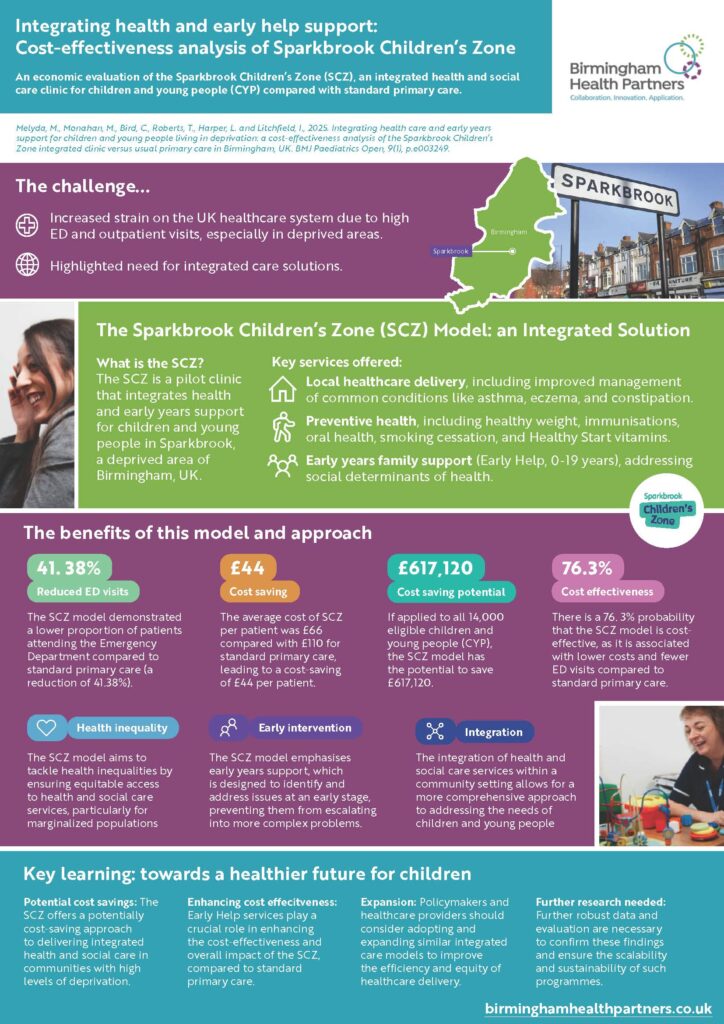
Integrated clinic pilot shows potential to cut costs while improving care for children in deprived areas

New research suggests that integrating health and early years support could ease pressure on NHS services while delivering better outcomes for families.

Undertaken by the Birmingham Health Partners (BHP) Evaluation Service, a detailed assessment of the Sparkbrook Children’s Zone (SCZ) in Birmingham found indications that integrating health care with early years and family support in deprived communities may be a cost-effective alternative to standard primary care.

The model-based economic analysis shows that children and young people accessing the SCZ clinic were less likely to attend A&E and require social care support compared to those receiving standard care, with an average cost saving per patient of £44 – achieved mainly by reducing referrals to children’s social care and emergency health services.

Sparkbrook, one of Birmingham’s most deprived neighbourhoods, is the first area to pilot this joined-up approach. The clinic brings together primary care, early years services, and family support under one roof, aiming to provide more holistic and preventative care.

Dr Mark Monahan, Lecturer in Health Economics at the University of Birmingham, explained: “Rising rates of child poverty, mental health issues and emergency hospital use show that our current systems aren’t working well enough for children and families in deprived areas. This pilot shows real promise in delivering better outcomes at lower cost, but we urgently need further evaluation to build the evidence base.”

The analysis showed a lower proportion of emergency department visits among SCZ patients (1.7%) compared to those in standard primary care (2.9%), driven by earlier intervention and integrated support, with SCZ patients were 40% less likely to attend A&E than those in standard care. This reduced reliance on emergency and social care services translated into significant potential savings, even with the limited data currently available. Early Help services embedded in the clinic were a key driver of cost-effectiveness by addressing complex family needs earlier.

While these findings are based on preliminary modelling, the results support NHS England’s ambition to develop more community-based, joined-up care models for children and young people.

The study also highlights the need for more robust and long-term data to support the national roll-out of similar models. It calls on policymakers, researchers and practitioners to work together to address evidence gaps and ensure these innovations are scalable, sustainable and capable of tackling entrenched health inequalities.

The Birmingham Health Partners Evaluation Service was established in 2022 to provide time-sensitive, formative evidence on innovations in healthcare and capacity building. It carries out rapid and effective service evaluations, often running in parallel with service implementation; helps spread learning to other sites; and helps build local capacity for in-house evaluations.

New partnership with ABHI places Birmingham at the forefront of healthtech innovation

A new strategic partnership with the Association of British HealthTech Industries (ABHI) will see Birmingham Health Partners (BHP) work collaboratively to unlock innovation, accelerate research translation, and improve health outcomes across one of the UK’s most diverse regions.

ABHI is the UK’s leading industry association for health technology (HealthTech), supporting its members – including both multinationals and small and medium sized enterprises (SMEs) – to save and enhance lives through developing products from syringes and wound dressings to surgical robots, diagnostics and digitally enhanced technologies.

This new Memorandum of Understanding (MoU) between ABHI and BHP reflects a shared ambition to better connect the HealthTech industry with the academic and clinical excellence embedded across Birmingham and the wider region. The partnership will provide a more coordinated route for HealthTech companies to access world-leading expertise, infrastructure and patient insight, enabling technologies to be developed and evaluated with relevance to real-world settings.

Members of ABHI and BHP meet in Birmingham to formalise the MoU agreement

The agreement signposts BHP as the “front door” to the region – a clear entry point for HealthTech and life sciences companies looking to collaborate across the city’s extensive ecosystem which boasts globally ranked academic institutions and attracts significant health and life sciences research funding.

Importantly, Birmingham’s population provides a powerful testbed for innovation. As one of the youngest and most ethnically diverse cities in Europe, with a stable and rooted population, it offers the opportunity to generate insights and outcomes that are both locally relevant and globally applicable – presenting a unique opportunity to develop and scale interventions that reduce health inequalities and improve access for underserved groups.

Women’s health and mental health have been highlighted as critical areas of focus, with both ABHI and BHP committed to closing gender health gaps through innovative approaches and technology-enabled, whole-person models of care – as well as helping to reimagine mental health care, deliver earlier interventions, and support more equitable outcomes.

The partnership will measure success against three overarching priorities:

  • Demonstrating measurable improvements in clinical outcomes.
  • Ensuring that technologies are scalable and relevant to population health, not just individual conditions.
  • Addressing inequalities in access and experience of care, in support of a fairer, more resilient health system.

This collaboration builds on recent findings from the Health Innovation Network’s Size of the Prize analysis, which highlights the £278 billion economic potential that healthcare innovations could unlock if adopted at scale. It reflects ABHI’s strategic commitment to nurturing regional partnerships that not only drive economic growth, but also deliver tangible improvements in people’s lives.

Main image caption Executive Director of Birmingham Health Partners, Professor Neil Hanley, and ABHI Chief Executive, Peter Ellingworth, sign the MoU agreement

New AI tools set to advance early cancer detection and prevention

Birmingham researchers are to play a role in Cancer Research UK’s recently announced £10 million AI detection programme, jointly supported by the National Institute for Health and Care Research (NIHR) and the Engineering and Physical Sciences Research Council (EPSRC) and involving 18 institutions including BHP founder-member the University of Birmingham.

Over the next five years, the Cancer Data-Driven Detection programme will harness vast quantities of data, link datasets and develop new tools to predict cancer risk – ultimately increasing the number of people diagnosed with cancer at its earliest stages.

The programme aims to access and link data from different sources – including health records, genomics, family history, demographics, and behavioural data – to develop advanced statistical models that help scientists accurately predict who is most likely to get cancer. Alongside this, the programme will develop powerful new tools which use AI to analyse the data and calculate an individual’s risk of cancer throughout their lifetime.

Researchers from University of Birmingham will take on specific roles in the programme, alongside approximately 40 others working together collaboratively. Professor Sudha Sundar, gynaecological cancer surgeon and a clinical academic in the University’s Department of Cancer and Genomic Sciences, is advising as a clinical practitioner in the multi-cancer risk prediction area of the work. Dr Ameeta Retzer from the Centre for Evidence and Implementation Science will lead on the cross-cutting Equity, Diversity and Inclusion theme, drawing on her expertise in health inequalities and research equity.

Dr Ameeta Retzer said: “Across the whole programme we will work to embed equality, diversity and inclusion since we know that cancer doesn’t affect everyone equally. It is vital that we ensure our research will benefit everyone, across all communities, equitably and that’s why I look forward to ensuring this strand of work has prominence in all areas of the programme.”

Over the next five years, the funding will build the infrastructure required to access and link these datasets, train new data scientists, create the algorithms behind the risk models and evaluate the algorithms and AI tools to ensure that they are giving accurate and clinically useful information about cancer risk.

The models generated from this research could be used to help people at higher risk of cancer in different ways. For example, the NHS could offer more frequent cancer screening sessions or screening at a younger age to those at higher risk, whilst those at lower risk could be spared unnecessary tests. People identified as higher risk could also be sent for cancer testing faster when they go to their GP with possible cancer signs or symptoms. Individuals at higher risk could also access different ways to prevent cancer.

Professor Sudha Sundar, whose clinical practice is based at BHP member Sandwell and West Birmingham NHS Trust, commented: “With cancer cases on the rise, it is essential that we work to identify and diagnose cancers earlier so that patients can begin treatments soon, which in most cancers vastly improves their quality of life and chances of survival. Screening is one way of identifying cancer sooners. Multi-cancer earlier detection tests represent an exciting progression in the scope of cancer screening programmes and this is part of the Cancer Data-Driven Detection programme that is exciting to explore further.”

The scientific programme will be guided by partnerships with cancer patients, the public, clinical experts and industry, while addressing ethical and legal considerations to ensure that the models and tools work well in practice.

Professor Antonis Antoniou, Director of the Cancer Data Driven Detection programme and Professor of Cancer Risk Prediction at the University of Cambridge, said: “Finding people at the highest risk of developing cancer, including those with vague symptoms, is a major challenge. The UK’s strengths in population-scale data resources, combined with advanced analytical tools like AI, offer tremendous opportunities to link disparate datasets and uncover clues that could lead to earlier detection, diagnosis, and prevention of more cancers.

“The Cancer Data Driven Detection programme will build the partnerships and infrastructure needed to make data-driven cancer early detection, diagnosis and prevention a routine part of frontline healthcare. Ultimately, it could inform public health policy and empower individuals and their healthcare providers to make shared decisions. By understanding individual cancer risks, people can take proactive steps to stop cancer before it gets worse or even begins in the first place.”

Earlier diagnosis of cancer saves lives. Yet according to analysis of NHS figures by Cancer Research UK, only 54.4% of cancers in England are diagnosed at stages one and two, where treatment is more likely to be successful. NHS England has set a target to diagnose 75% of cancers at stages one and two by 2028, and this will only be achieved with research and embracing new technologies to catch cancer earlier.

Professor Lucy Chappell, Chief Scientific Adviser at the Department of Health and Social Care (DHSC) and Chief Executive Officer of the NIHR, commented: “Detecting and diagnosing cancer earlier is key to improved survival and quality of life for patients. By leveraging AI to enable healthcare professionals to identify people at a greater risk of cancer, this initiative could improve the way patients are screened and diagnosed. This programme’s AI-driven insights could lead to more effective treatment and improved survival, helping patients to live longer, healthier lives.”

The Cancer Data Driven Detection programme is jointly supported by Cancer Research UK, the National Institute for Health & Care Research, the Engineering & Physical Sciences Research Council, Health Data Research UK, and Administrative Data Research UK.

You might also be interested in: